Showing posts with label Johnie Stapp. Show all posts

Monday, July 1, 2024

My Story--The Fire 1984


          It was 4am before the flames were high enough to rouse the neighbors.  Sirens rang as truck after truck sped through the streets to reach the raging fire.  The neighbors stood in nightgowns and thrown together layers of clothes, starring in awe as the 1927 Tudor structured clubhouse burned out of control like an angry lady poking a stick at mad dogs.

          With water hoses surging full blast from all angles, photographers shot pictures of the fire in the night, while word spread throughout Miami, Oklahoma that the club was burning.  Shortly after sunrise it became clear that flames had reached the fifth floor and were screaming through the roof.  Windows had exploded floor by floor, and the town had turned out to see the event, like a circus train unloading lions and tigers.

          It wasn’t known how or when the fire started on if anyone was inside.  The housekeepers from time gone by no longer lived on the fourth floor.  Cars had sometimes been left overnight by members too drunk to drive.  Had the men gone home or stayed behind to win a hand of cards?

          For me, the club was like a home, my touchstone of who I was, who I could be, and eventually who I would become.  We moved to Miami, Oklahoma in 1954 a few years after the flood of ’51.  As a child of five my greatest regret was that we missed the flood, but oh did I ever soak up the stories and seek out proof of flood lines on homes at every outing.

Ladies on the practice green on the north side of the country club.1960's

          My dad was the golf pro at the Miami, Ok. Golf and Country club  and the greatest teacher I would ever know.  In turn, I played golf and loved the fresh air, but it took hours of my life to prepare for tournaments.  Practice was my life as a teen, whereas, my sister was a natural and still has an easy flowing flawless swing. (I must confess we both worked hours on the practice tee. Golf is never easy, even for a person with natural swing.)


1967 South-side main entrance with our blue station wagon that would take me to college in 1967 sits to the left of the entrance.

         I went to work in the golf shop at thirteen.  Tuesday through Saturday I opened the shop by sun up in those summer months.  From 2:00 till dinner I played or practiced my golf game. By the time I was a full-fledged teenager I had very little time to drag main, shop with friends, watch “As the World Turns”, or date. What I did have were the friends I made at golf tournaments in those years and the experiences of playing at the highest level of junior golf in 1960's before Title IX.

          Part of me always wanted to be like everyone else, but the other part was willing to stand alone and just be me.  I didn’t know who me was or would become.

          At nineteen, 1967, I left home for college at LSU to complete a teaching degree. Being immature, thinking I was smarter than my professors, I came home in the summer of 1968 married and left home for Ft. Hood, Texas.  Five years later I was a mother of a beautiful child, but divorced, uneducated, and alone. I left home again, and worked my way through college and degrees.  As a librarian, teacher, and mother I began to entertain and teach through storytelling and puppetry.  And we laughed.

          The stories told, laid the next layer of asphalt for the road I would take.  I found those universal truths of stories to be healing for the human spirit.  Listening to the laughter of the crowd rejuvenated me.  Listening to my daughter mimic me as she retold those stories to her dolls and friends, also made me realize how our children watch in detail our every move.

          It was the stories that led me home that weekend the club burned.  On a Sunday July 16, 1984 I drove from Norman, OK in a green Toyota loaded with kids, puppets and books and drove straight to the club.  I needed to feel the soil of my soul and show my children a part of me.  On the horizon I saw only two chimneys.  One four story chimney stood in the center of the broken brick shell, ashes smoldering, people still standing rows deep in the drive way watching. The second chimney stood alone on the west side of the building that connected the dance floor and porches to the main building.  Fire trucks and traffic blocked my entrance.


North-side from the putting green.

          I parked on the street and walked quietly cautiously toward the smoldering structure, my broken lady. My children ran ahead. 


July 23, 1984 Dad, Johnie Stapp, myself, daughter Katy Rains, and stepson Michael Watt.

     When my father saw me, the tears he had held off since the wee hours of the morning fell down his cheeks in rivulets flowing haphazardly.  The hugs and tears came from all directions.  All any of us could do was stand, stare, until at last we began to share.

          On Monday after teaching summer school at PSU, I returned to the club and parked near the yellow tape on the south side.  I followed the tape around a giant circle to the north-side and the entrance to the pro shop.  No lives had been lost, but, oh, so many memories danced in the clouds.  I stood outside the yellow tape. Then I heard a choking voice coming from the ashes that were heaped where the golf shop once stood, supporting the lofty building. From an angry grumble I heard these words,  “Where are you?  I know you’re here.  You’ve got to be here.”

          Quickly, I crossed the line and hollered, “Who are you?  What have you lost?”

          A deep angry voice returned, “It’s John.”

          “Dad?" I rushed through the door frame,  "I thought you were at home.”  

     Stepping into the ashes of golf shop door, I saw a bent over white-haired man swinging a rake wildly at a pile of ashes.  I thought for a moment his khaki jumpsuit was streaked in blood, but my imagination was vivid and dried red paint had the same effect.   Then I realized it was another man, named John, not my father. 

          “Oh my gosh, John, this is Letty Stapp, the pro’s daughter.  What have you lost?”  I asked fearfully.  He stopped, turned at me, and hollered,  “I’ve lost my putter.  She burned up, but I know I can find the mallet head.  Come here and help me, now.  You know where my bag was stored.”

          With two of us digging, and my clothes already covered in ash, we found the mallet head, no wooden shaft, no grip, nothing else to be retrieved.  With rake and mallet in hand we walked to the outside of the ropes and behind the yellow tape.  No words were spoken as we turned to look at shell.

          At last I said, “You know she was my home, my touchstone.  I can see myself and your children, all of us up there in the attic playing and spying on the world below.”

          “It was my home, too,” he replied.  “My father, James Coleman,  and George Coleman had her built.  I grew up there.  I know every nook and corner like the back of my hand.”  One by one we shared our stories through tears and laughter that spanned six decades.  Secrets had been shared.

          Then he placed his arm around my waist and said, “I’ve always said a man is just as old as the woman he’s touching.”  I laughed, for he was known to be a fox around women, but I knew that for a few moments in life we were both younger and shared a deep feeling for a burned out building called home.


*A true story by Letty Stapp Watt, as told for three decades on storytelling stages throughout the Midwest. 

**Later that week John Robinson drove to the farm where my parents lived and asked dad to remake his mallet head putter. It took a few weeks before my father found a wooden shaft that would work. 

***Sadly, my mother had finished updating the Miami Ladies Golf Association scrapbooks and delivered them to the ladies locker room a few days before the fire. Without pictures in that scrapbook I thought I had lost a part of me, but the memories floated back easily. In retirement, I took up the mantle (or mallet head) and wrote the history of my club from 1916 to 1984.

****Luckily, the club rebuilt and there are more stories to share. Click on this link to read our history: Miami, Ok. Golf and Country Club Stories

Tuesday, May 24, 2022

Miami Memories--Dirt Track Racing


          My father, Johnie Stapp,  loved to work on cars, build cars, drive cars fast, and travel.  Since he didn’t have a son, I became his shadow and helper.   When I learned to read a road map better than a textbook, my mother described me as a curious child to her bridge club friends.  I understood that it was a survival technique after having experienced my father’s verbal frustration at mother’s inability to read a map and give directions.  Learning to read road maps served several purposes for me.  One, by sitting in the front seat on long trips I was less likely to vomit from car sickness   Secondly,  I could honestly read the maps and signs well enough that we didn’t get lost. Third, I didn’t have to sit in the back seat with my little sister and get in trouble for touching her half of the bench seat. At some point Dr. Graham told my parents about drug called Dramamine, which knocked out children and they slept through curving and hilly roads. When I took Dramamine, my power of sitting up front was taken away from me. I didn’t always have to take the sleeping pill, as I called it and over the years and miles of travel, my skills of map reading came in handy preserving peace in our family.

No one could take my energy and curiosity about racing and race cars away from me.  When my father bought his first fast car from George Coleman, Jr., I was barely big enough to look out of the window of the shiny green 1952 Oldsmobile.  It was our family car. Dad with the help of his mechanic buddies from B&M garage on Main Street, Miami, Oklahoma kept the engine running at top speed.  With its V8 engine it could now race quarter mile straight out on dirt tracks.   The nearest track with a quarter mile straight away for that type of racing was in Missouri, near Joplin.

        My eyes nearly exploded the first time I sat on a wooden bench with mom and my little sister, Jonya, and watched the cars scream by me.  Dust, dirt, and engine heat filled my nostrils leading my lungs to scream, “Faster, dad, faster.”  Mother pulled at my shirt tail keeping me away from the fence as I continued to jump and yell, even though the race was over.

 I don’t remember that we attended very many races, but I do remember one particular nigh when I was in third grade at Lincoln school (1955-56).  We had watched several other races and it was nearing dad’s turn.  He stood up and turning to us said, “Tizzy how about taking a spin down the track with me?”  I’m sure mother had to grab my shirt tail, as I leaped high off the bench in jubilation.

 “Now Johnie, I don’t think that’s a good idea.  Anything could happen out there, and besides she gets car sick.  How could you forget that.” Mother cried in a demanding voice.

“Helen,” Dad replied with a sigh in his voice, “she’ll have a seat belt on, and it’s a straight race to the finish line.”  

“Mom,” I pleaded, “you know we’ll be safe because we always wear seatbelts and I like it when Dad drives fast.”

Mother gave in.

Taking me by the hand we walked past the bleachers of people down to the parking lot and into the Olds.  Suddenly, my insides pounded and I knew I had to tinkle, but  I guessed that if I told dad I needed to go tinkle, I’d lose out on riding in the race.  The next thing I knew I was buckled into the front seat starring out the open window at the people in the bleachers.   We sat there for eternity waiting our turn, while my eyes scanned for mother and Jonya.   The car reverberated in place as dad kept one foot on the brake and one on the pedal, then with a burst of energy the car leaped forward, and I bolted backwards into my seat forcing me to sit tall and straight as the people in the stands and the wire fence blurred past my eyes.  I’d imagined of waving as we flew by my mom and my sister, but instead my body buzzed with excitement.  I don’t remember whether dad won or not.  I only remember the feeling of humiliation as I realized I was sitting in a warm puddle in the front seat of the car. 

After we drove off the race track and back to the lot of parked cars, I pulled myself forward to get out of the car, then froze in place as the warm lingering buzz of the race trickled down my legs and cold tears filled my eyes.  “Daddy, I couldn’t help it.” I whimpered, not making eye contact with him.  “It just came out of me when you hit the gas. I couldn’t stop it, I couldn’t help it.” 

My words continued to babble from my lips making no sense until Dad raised his voice and patted me on the back.  “You’re fine, Tizzy. Now take a deep breath and stop crying. Your mother is walking over here.”  In my head I wanted to stop crying, dry off and look cool, but in my heart I just wanted to run from my own humiliation.

 I never believed that dad was angry with me for wetting my pants, but I think he was concerned about what had just happened.  What had he done?  Had he crossed a dangerous line with his oldest daughter?  I had no fear as a child, but I think it was events like this that helped me recognize danger, and how to stand my ground and say, “No.” 

Out of the car it, was clear that I had wet my pants.  When mother saw what happened she reached for my little sister’s hand and stared at my father, rather than hug me.   Then in a rather icy voice she spoke, “See there Johnie, you’ve scared her to death.  Letty’s just a little girl.”

“Damnit Helen, she’s fine.  Grown men have done the same thing.  She’s not afraid.”  Then they both looked at me.  When I heard the anger in their voices, the tears quit flowing, and I stood alone glancing at my parents then at my little sister.  She was holding tight to mother’s hand and trembling with fright, I think more from their voices than from the dirt track races.  Finally, the quivering deep down inside of me released my voice and I shouted, “I’m ok.  I’m ok.  It just made me go tinkle, that’ all.” 

I tried to think of something funny to say, to make us laugh and the anger go away, but no funny words came.  It was a quiet drive home, always eerily quiet after mom and dad argued. 

Arguments weren’t uncommon in our household, but they were most painful to me if my actions had caused the fight.   To this day I’m not comfortable with people arguing, and I will avoid confrontation whenever possible.  As a child who keenly observed people, I knew then, as I know now that no one wins an argument when feelings are hurt with ugly words.

My accident, as mother called it, didn’t stop us from following dad from time to time to the drag races in the green Olds.  There seemed to be some subtle agreement between mom and dad that I wouldn’t be in the race car on the track again. I never lost my curiosity and thrill of riding with my father, especially after he bought the Muntz from Lou Newell in the late 1950’s.

**This story came from memories I have collected as I research the history of my home and golf course. My history story from Miami, Oklahoma can be read at Johnie Stapp--The War years to 1947

*Search for other blogs about MIAMI MEMORIES in the search bar above right.

*Thank you Bobby Poole for helping me with pictures and locations of our Miami childhood memories. 


Tuesday, November 9, 2021

A Part of Herstory Comes to LIfe

A part of herstory, my story, is history and a colorful journey through the time in which my parents grew to adult hood. 

The Golf Gypsy, Literally Letty

In July 1984, my home, the Tudor style clubhouse in Miami, Oklahoma burned to the ground. To this day, a part of me can walk through the clubhouse from the basement to the top attic home, where custodians of her history lived.  I walked and crawled through the empty attic and listened the sounds below. The children's room balcony, the bar, the locker rooms, the golf shop, and **snake pit my father dug out of the clay basement where golf carts were stored, all are part of my deepest memories.  My childhood and that of my sister's, Jonya Lea Stapp,  began there  in 1954 when our father and mother moved from Independence, Kansas to Miami to take the job as Head Professional Golfer and Instructor, along with greens superintendent, and manager of the clubhouse. 


In those days, the golf professional made his money from a salary, giving golf lessons to members, golf shop income, and in the middle fifties, dad bought the first set of gasoline golf carts. The income from the golf carts became the money that sent my sister and I to college. Mother became the book keeper for the golf shop, but the larger income from the social gathering aspect remained on different books, kept by a secretary accountant. The country club was privately owned and operated by its members, so my father reported to the President of the club from year to year. 

Because my parents shared so many roles in the running of the golf shop, my sister and I were practically raised there, even though we lived in town. As a result my childhood memories are filled with those colorful people and days.

The country club began in 1914, thanks to the foresight of a committee of men, and one major investor, George Coleman.  1914-1929 Rockdale Country Club


Our very first golf professional in 1921, was Ed Dudley, who went on to become the first Golf Professional at Augusta National Golf Club. He was hired by the most notable amateur to play the game of golf, Bobby Jones.  Ed Dudley's Golfing Career. Dudley designed the original four golf holes with sand greens. 

Pieces of Professional Golf History in Oklahoma began to fall into place as I read the newspapers from Miami, Ok, and Joplin, Missouri. One quick fact that caught my attention was this line from 1924 April 11:

1924 April 11    G. L. Coleman elected President of Rockdale CC by the seven directors: Ed Millner, Ross R Bayless, J.A. Robinson, A.C. Wallace, L.A. Thompson and R.W. Skinner.

Rockdale CC will become a member of the state golf association, which will give all members of the local club the right to play on the course of any other club in the state, which is a member of the association without having to pay a green fee.

Can we even imagine times like these? Women were playing golf and our local newspapers carried regular information on calendar events for both women and men.  

When the depression hit the country, citizens of Ottawa county and the Tri-State area, were not hit as hard as other areas of the country, because of the discovery of lead and zinc in the late 1800's. By World War I the Tri-State area of Oklahoma, Missouri, and Kansas became one the most prolific producers of lead and zinc that were needed for the war effort. As a result lead and zinc mining kept the area employed. Sadly, there were no government regulations placed on mining in those days, as a result our current history of my home area is darkened by the EPA reports of the poisoned Tar Creek area of Ottawa County. 

Between 1927-30 George Coleman a major investor in the mining area built one of the world's most  renowned theatres:  The Coleman Theatre which opened April of 1929. 


That same year in December the Rockdale Country Club opened its doors to the new Clubhouse.


This building c. 1929 became our home from 1954--1976 when my father retired. 

From 1928--1946 the Miami Golf and Country Club became a regular host for the Oklahoma PGA. However, reports vary on this particular golf tournament and records that might have explained when it was medal play and when it was match play burned in a fire a few decades ago. I found it quite exciting to read how involved the community of Miami became in the game of golf thanks to the newspapers coverage of the tournaments and the well-known names who came to town. A gallery was a regular at these events. Miami at that time had caddy's and a caddy shack located off the north side of hole #1. Oklahoma PGA Championships

Through the 1930's golfers in the tri-state area, including women, traveled often to play other golf courses. Often our Miami New-Record ran AP and other sports stories. This is one I found especially interesting:

1932 April 7 MNR The headlines read: Headaches May Help Lower Golf Score according to Dr. C. R. Griffith, psychological research director of athletics at U.of Illinois. "The golf player with a headache has the advantage over his companion who feels 'fit as a fiddle.' The headache keeps him from pressing and from experimenting. He is out merely to play the game and this means he is out to do that which he has been most in the habit of doing." "If a man goes into a golf game feeling fine, either of two things may happen. He may start to make each hole in one and thus be guilty of pressing. Or he may experiment. Pressing breaks up timing and rhythm. Experimenting may lead to disaster. The man who has a headache or is not at his best, will not be guilty of pressing. He will play his natural game."

There may be some hidden truth to this statement.

In 1934 funds were raised by a team of Miamians to purchase the debt of the Rockdale Country club and change it's name to the Miami Country club. 

Though most of the sports writers used very descriptive language and vocabulary there were a few writers who gallantly took time to rib the local golfers and their status in the community, many of the events that would presently make Facebook news:

 George Coleman, Jr, club president, has suggested that the Miami membership stage a big stag party on the eve of the pro-am, draw names of the amateurs with the pros and form a Calcutta pool. A percentage obtained from the pool will be used for cash prizes for the pros and merchandise for the "simon pures." (Men of  financial means were sarcastically called 'Simon Pures' by the press or media. They were considered men who could play golf six days a week pick up a little cash, and call themselves amateurs.)

The women golfers were also active social ladies and bridge club members. They took on the roles of organizing seasonal decorations and dances, selecting area bands to play for entertainment, helping with various local groups. Well into my childhood through the 1960's I remember the earnest attention they gave to decorations and modeling of the newest décor. 

St. Patrick's decorations, spring violets and an abundance of good food, together with the hospitality extended by the three hostesses, Mesdames H.B. Coban, Carl Britt and Lloyd Newton, made the ladies' day at Miami Country club one of the outstanding of this season. Potted Shamrocks, green tapers and crepe paper were used on the luncheon tables. High score at the bridge was won by Mrs. A.C. Wallace. The sewing prize was awarded to Mrs. Roy Green. The next luncheon will be served by the club cateress and the hostesses on the occasion will be Mrs. L.A. Wetzel and Mrs. Matt Connell.  Members playing in foursomes are urged to have lunch with the group and play at reserved tables afterwards. There will be no additional charge for such reservations.

Note that the women were referred to as Mesdames through the 1940's. First names of the women were rarely if ever used in reference to golf tournaments and scoring. They went by their husbands names. This piece of history can be seen on the trophies of the era through the 1970's. 


This small red tee, only one inch and a half long, is a personal souvenir from a thirteen year old golfer and Bing Crosby fan, Sarah Hilliard Mirjanick. Sarah received this autographed tee from Bing Crosby on the day he played golf in Miami. (September 25, 1942) The picture of the tee is shared by Sarah's daughter, Rebecca Mirjanick Davis. 


**Stay tuned for the TIMELINE and personal stories that I can add through the 1950’s and 1960’s. Use this URL to access any of the Miami Golf and Country club blog:  <https://mgcchistory.blogspot.com/>

** The snake pit might have seen snakes wonder through it, but it was built or dug out for the purpose of practicing golf during the winter. My father set up a mat and a large indoor/outdoor net that held the golf balls hit from a player on the mat. There was room for only one player (or one couple hiding behind the net and kissing). It also stored hidden beers and liquors that were illegal in Oklahoma in the 1950's-early 1960's. 

*** To read more stories from the early days of golf in Oklahoma and the Miami Golf and Country Club TIMELINE please click on the following links.

1914-1929 Rockdale Country club  Later Rockdale became the Miami Country Club

1930-1934 Miami Country club 

1935-1937 Miami Country Club

1938 The Club Enters a New Era

1938 Miami Country Club

1939 Miami Country club

Ed Dudley's Career

Tee Shots: Golf Lessons

Oklahoma PGA Champions

Golf's Man of the Decade 1930-1939

1940 Miami Country Club's Course Layout


Friday, August 6, 2021

Nomads


Jonya and Bill
Jonya 

         This summer my sister and her husband have traveled the north central plains states in their RV. Jonya retired from teaching after nearly forty years. To help her adjust to retirement they decided to travel with their cats to keep them company. I can tell from the photos that they send that Jonya and Bill have both taken time to unwind from the working world. Nomadic life looked pretty cool from my perspective. 


The story written below is of the Stokes family we knew who were real nomads. No cameras no pictures no cell phones were available to them. The atlas was their Bible.  They never owned a home and were on the move in an Airstream trailer after every job that Dale finished. I only wish I could  recall his stories of working from the great Southwest to the Northwest in the 1940's, 1950's, and 1960's.  


  One hot humid summer day on E street S.W. when I was seven years old, our house was rattled by the blaring blast of a cow horn coming from a car pulling up in front of our house.  Leaving dishes in the sink, then quickly drying her hands on her apron, Mom rushed to the front porch with Jonya and I following closely.  “They’re here already.  Dale and Elsie are here,” she joyfully pronounced, “I thought they were days away.”

            Jonya and I just stood in the screened in porch watching as a man and woman stepped out of a boxy shaped car that was pulling a sleek silver trailer.  Then we heard Elsie’s enthusiastic voice call out, “Hi girls.”

            “Elsie, “ I yelled, when I recognized her voice and her open arms.  Leaping down the steps I ran to her open hug.  Mom was right behind me giving Dale a hug and then Elsie.  Jonya tugged at me, I turned and said, “It’s Elsie and Dale, remember, mom and dad’s friends from Arizona.”   She was only three, so how could she remember, I suddenly thought.  So I tried to explain, “Remember, Elsie is the lady who loves to swim and play games with us when she visits.”  Just then Elsie stepped over to Jonya and knelt down on the ground eye level, “Hi little one.  My name is Elsie,” then turning and looking up she continued, “This is my husband Dale, and we’re friends of your mom and dad.  We’re going to spend some time with you this summer; playing golf, swimming, and fishing.”  Jonya seemed to catch on and shyly smiled, “Will you play dolls with me?”

 “I’d love to play dolls with you, since I don’t have a little girl to play dolls with anymore.” Elsie answered with a smile that showed her large teeth.

“You’re a few days early, your letter said middle of August to Labor Day.” Mom said rather flustered.”  Before she could continue Dale answered, “I finished my last job early, so we just took off.  Thought we hadn’t seen Johnie and Helen and the girls since their move to Miami, and that this would be a great summer trip.”  Just then I remember that I had slept in their trailer when we visited them in Arizona.  “Can I sleep in your trailer while you’re here?” 

Using a rather firm voice mom said, “Letty, let’s get settled and call Dad at the club before we do anything.  Dale and Elsie come on into the house and have some tea or a beer while we make plans.”

After a cold beer, Dale’s voice boomed, just like his car horn, “Helen, do you have room for our Airstream in the back yard?  We could park it there before John gets home from work.”  “Yes, yes we have a big backyard,” I chimed in, only to receive the stare from mom, that I was to be silent and let the adults decide.

After examining the alleyway and the unfenced yard, Dale pronounced that there was plenty of room.  Without any arguments or advice he drove the trailer around the block and up the alley.  Elsie directed him flawlessly into the yard where he parked the compact trailer.  Then the two of them went to work unhooking the car, balancing the trailer, rolling out the awnings, opening windows, and setting the wooden steps in place by the door.”  By the time Dad came home from work, they’d moved in. 

The neighborhood kids arrived in groups to see what silver bullet had just pulled through their alley.  The Bothwell’s, the Searle’s, and the Hammonds next door all showed up to see the commotion.  Holding Jonya’s hand, we proudly stood outside with them, showing off our newest addition, like proud owners of a new toy.  Since it was nearly dark, Dale and Elsie promised the neighborhood kids that tomorrow they could come back and take a tour of their trailer. 

The Flying Cloud 
Airstream design from the 1950's

That evening the lawn chairs were set up in the backyard, a red metal chest with cold beer set between Dale and Dad.  As they drank a few beers Mother took us inside and fixed our dinner early, as she did most every night in the summer when dad worked till dark.  When we’d finished our meal we were free to play till bedtime, while mom and Elsie joined the men for a few drinks.  Elsie drank beer like the men, but mother preferred Scotch.

  Dad loved to grill outside in the summer when we entertained company.  Pulling the homemade trash barrel BBQ grill away from the house to the gravel driveway away from trees and bushes made the fire breathing dragon seem innocuous.  I sometimes helped by placing the black dry charcoals in a coffee can. Dad would soak the coals in gasoline until he was ready to start a fire.  His fire starting method always scared mom, so she’d grab us by the arms when possible and yanked us back with a comment like, “I don’t want your eyebrows singed.” 

  At last he would place the soaked coals on the grill and surround them with dry coals from the sack.  With a warning cry, “Stand back,” he would light a couple of matches and toss them on the pile of gasoline soaked charcoals.  Like fireworks the flames leaped high above the grill lid and the smell of burning gasoline radiated through the air.  After another drink or two dad would place the steaks on the grill while mom prepared the salad with homemade vinegar and oil dressing, bread and butter,.  By then it was our bedtime and the adults finished dinner and drinks alone.

During the next few days we woke up to Dale’s jovial voice at the backdoor, “Stappie, you got the coffee ready yet?”  Then we’d hear the screen door open and bang shut.  Mother was the coffee drinker, not Dad.  “Coffee is served,” Mother responded.  After the adults finished breakfast, a cigarette and coffee, Jonya and I crept into the kitchen.   Dad left for work, then Dale loaded up his heavy car with tools and drove out to the club to spend the day fixing things for Dad.  

I loved our nomadic friends. Dale was an electrician by trade. He and Elsie traveled the west coast year round looking for jobs. They raised one daughter, and were like family to us. 


Friday, January 1, 2021

Touching Lives ...He Was a Good Man


A story, that I have been a part of since World War II ended and baby boomers filled the hospital beds, has now reached closure. 


Elementary school taught me one major skill that has sustained me. My favorite part of the week was "Show and Tell" not recess.  My parents each saved memorabilia from their forty years of life's experiences. They told me stories about places, people, and items. I took in every story whether true or exaggerated. 

The memory I will never forget is standing in front of my fourth grade class at Roosevelt. I smiled and felt proud as I told a story of my daddy meeting an important doctor in Japan after World War II. One boy interrupted and bullied me with, "You mean a Jap." 

I sucked in my breath and continued, "Dr. Aoi and my father are friends. We write letters back and forth like pen pals."  I am sure Mrs. Bloomberg helped to ease the situation.  "Dr. Aoi and my dad played golf together. That is why they are still friends." 


This is the only remaining Christmas card from my dad's correspondence after WWII with Dr. Setsuro Aoi. For over a decade in the 1950's my father wrote and shared pictures of us with Dr. Aoi, whom he met after World War II. Dad was stationed in Japan after the war. My guess is that he had skills to fix things, he never met a stranger, and he played golf. 

I carried this letter in my cedar hope chest from the day I moved away from  209 H NE in 1968 to the present.  While living Hutchinson, Ks we met a couple from Japan. Yuka and I became friends. Then a few years ago this lovely Christmas card surfaced in one of my discarding/ cleaning out moods, and I decided to find out who Dr. Aoi was. Yukari willingly helped me by posting this picture with a message in search of Dr. Aoi's family on Facebook. 

We first learned that Dr. Aoi had been a doctor at the tuberculosis hospital  in Nagoya, Japan.  His niece sent this message:

メール有難うございました。アメリカのお友達がカードをまだお持ちなら写真を撮ってPCに送って貰う事は可能でしょうか?次女の方は独身で両親を看取り現在は名古屋市の施設におります。長女は90才、次女は87才になります。まだ元気なようですが父親の送ったカードを見ることが出来たら懐かしいのではないかと思います。多分PCなどは持っていないかと思いますので私宛に送って頂いたら何とかします。コロナ騒動で現在は緩和されたとはいえ私は三重県ですし直接は会えないかも知れませんが。

" Her father is a brother of Dr. Aoi who you are looking for. She said Dr. Aoi passed away in 1980 at the age of 82. He got two sons and two daughters. The eldest son passed away, the second son was in the USA and married an American woman who lived in California!! but he has already died. She said if she knew the story at least ten years ago you could have seen him. She asked two daughters about your father but they did not know any episodes about American man."  

IF.  If I had just done this research when I lived in Kansas. The great IF, but I didn't. 

In the last year Yuka and I have kept in touch with updates from Dr. Aoi's niece. As of June 2020 Dr. Setsuro's brother's daughters were still fine, ages 90 and 87. 

In a more recent email Mitsuko, Dr. Aoi's niece writes: 

"Your father's friend Dr Seturo was a very talented person. After graduating from medical school in Japan, he was studying at the University of Bern in Switzerland.

From that experience, he accompanied as an advisor to the Japanese representative of the Berlin Olympics. He became the director of the tuberculosis sanatorium during World War II, and probably met your father there after the war. 

His son, Mitsuko's father, was also a doctor. He went to North China as a medical doctor. At the end of the war he was interned in Siberia and missing forever It was a really sad story." 

Yuka writes:  No more war.

                     No more COVID-19

                    Love and peace. 

I replied, "Yuka, this is the best gift of the year. I think we can close the story and know we've done our best by history and loved ones. I thank you for your sincere help in finding this information. Hope you are both well and safe from COVID."

One last note sent by Misuko reads, "And most of Dr. Aoi's family are doctors. They are fighting COVID-19 right now." 

Letty writes: No more war.

                    No more COVID-19

                    Love and peace.


**Update January 2021:


In a box my father carried with him I recently rediscovered the Japanese fan that Dr. Aoi sent to us in the 1950's. Once again I asked my friend Yuka for help in translating the words on the fan. The best news of all the translation down the side reads: Made my Hotel Taigetsu-row in Toba-harbor. Taigetsu means waiting for the moon.  

Toba, she writes is a beautiful place to visit. Here is the website: 

Toba Harbor


Tuesday, May 5, 2020

SupHer Power Golf Warm-Ups On the Go

Patty Berg clinic, with Dave Marsh Wilson Rep, Mickey Mantle NY Yankees, and Johnie Stapp, PGA pro,Miami, Ok. Country Club  c 1956


As the daughter of a Professional golfer, growing up in the fifties and sixties the idea of physical stretching before teeing of was unheard of, with the exception of Patty Berg, who visited our Miami Country Club in the 1950's as a Wilson Club representative. She concentrated on helping women play golf with the sole purpose of seeing women 'invade the fairways.' 

Long before Miguel Angel Jimenez's hip movement stretches made the sports news, Patty danced and stretched, all the while talking to the crowd about golf, about sports, about travels, anything to make us laugh and love her even more. Her dance type moves allowed her body to maintain the fluidity needed to swing for the crowd. So rather than do precise stretches to stay loose, she moved her body and limbs repeatedly, allowing her play amazing golf.

Patty Berg, Early Professional Years

The last few Friday evenings during our Covid 19 stay home stay safe season of life, I have been fortunate to join the Virtual Play Day golf clinics given by SupHer Power Golf for Women.

April Kenyon, Dr. Beth Brown, Coach Nancy McDaniel


My golfer's mind and body have benefited from each program, and perhaps mentally benefited the most from the much needed pre-game warm-up routine that Nancy McDaniel offers each week at the beginning of an episode.  Without being physically and mentally prepared to play golf we often set ourselves up for failure until our bodies begin to sync with the rhythm of the golf swing.

The first clinic when I heard Coach Nancy (Hall of Fame Women's Coach for Cal Berkeley) describe the urgent need to stretch before jogging to the first tee with barely in time to tee off, I laughed and thought to myself, “That might just be what I need.” The mental connection she gave me was to give myself the grace to play the first few holes at 85%, to lighten up on myself. By incorporating these suggested quick stretches the back can loosen up, allowing each of us to swing with less stress on our muscles.
Coach Nancy, twisting the upper torso.

We have all been guilty of arriving for our tee times with minutes to throw the clubs on the cart and head off to the first tee. Here is what Nancy suggests:

    * Before leaving the space of the car, inside or out, close off all communication with the outside work/family world.  Take a deep inhale pushing the belly muscles out like an inner tube, being sure to keep the shoulders heavy and low beneath the ears. Once helps, but 2-3 times is better. 

     *Jog slightly or take giant steps to the cart, gathering area, or first tee. Get the blood to flow, and give yourself the gift of the warm up stretches.

   
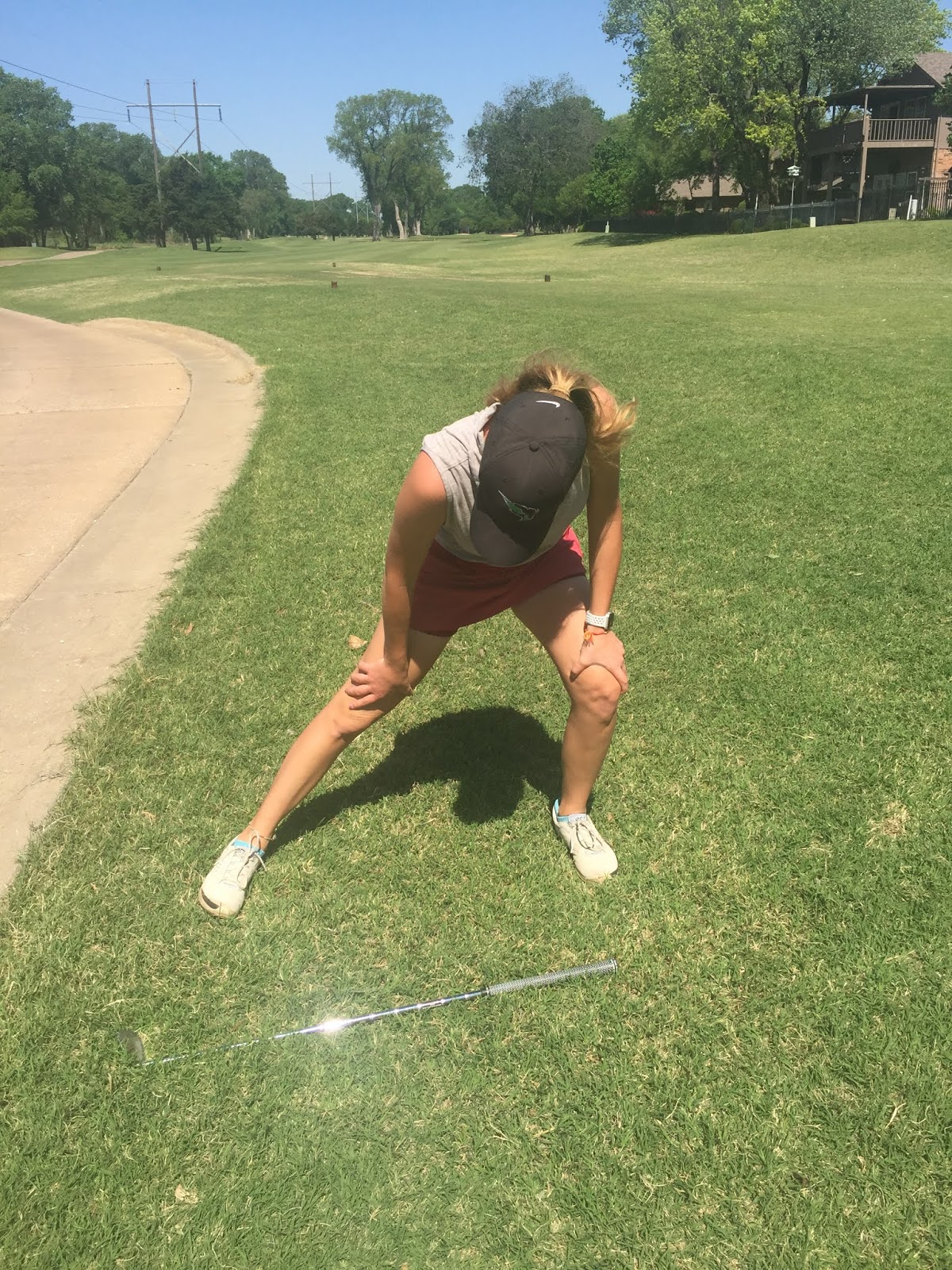
Hayden stretching her wrists after working
on her computer all day for her college
classes. 
     *If putting is a weakness or concern because of tension in the upper body, then begin with neck circles, wrists and arm flexes being sure to use the core muscles to hold the balance. This helps to release tension of the day and to alleviate golfers/tennis elbow. 


Coach Nancy hip/piriformis stretch.

     *On the tee box or as the group gathers to hand out scorecards, explain that you can talk and listen while stretching. Then pick a routine for stretching that fits your body's needs, such as starting at the top down.  As for me, I often begin (in the middle) with the piriformis stretch (think letter 4). My hips and hamstrings are tight. This stretch I can do near the golf cart holding on for balance, if I am running that late. Then I continue down the legs with the hamstring stretch and end with some kind of arm or core body twist.  


     *Overall movement might begin with top rotation and work downwards. 
Hayden Meiser, OBU Girls Golf Team


Leg swing back and forth. 
For instance, stand on one leg using something for balance and swing the free leg back and forth. This loosens the hips. Then begin to engage the torso with various twists.


Hayden stretching inner thigh allowing
greater rotation. 


  *Make sure to perform one to three squats to activate the glutes. It doesn’t require a rotation of 10x10x10. Simply start in a golfer’s stance then release arms into a squat, hold for a couple of seconds and repeat. This is not the gym, it is stretching on the go.   
Coach Nancy McDaniel in the
squat position using a club
for balance. 


   *To help with balance and swing movement place your hands across the chest, with a golfers stance and posture swing the body back and through. It is important to finish with ‘spikes up’ and body in balance.


    *If you cannot finish a top to bottom round of stretches before teeing off, then step off the golf cart when others are hitting their next shot, and stretch at every opportunity, until you feel free to swing through to the target, 'spikes up' as Nancy calls it. 

  
'Spikes up' helps with the follow through. 


Remember to modify as needed for your body's needs, abilities, or aches/pains, and to provide your body with plenty of water. The brain is more responsive when it is nursed by water rather than drained, feeling dehydrated, and unable to think.

The first time you hit a great shot, sink a putt, or chip like a pro, do the Patty Berg dance of celebration to anchor the greatness of the moment and to continue to keep the body vibrant and loose.


***For more information on SupHer Power Golf for Women please contact one of the following team members:

April Kenyon <april@supHerpowergolf.com
Nancy McDaniel <nancy@supHerpowergolf.com
Beth Brown <beth@supHerpowergolf.com

SupHer Power Golf for Women This is the Landing Page for future courses and events provided by SupHer Power Golf. 

For other golf tips/ health tips click on the links below:

Finding Balance

SupHer Power Golf


c. Letty Watt,
historian, golfer